
Educational
Grow mushrooms in the classroom
With Minichamp’s educational growing kits, students discover step by step how mushrooms grow. They see the process up close, tend the kit themselves and eventually harvest their own mushrooms. Ideal for lessons on nature, technology, sustainability and healthy eating.
Organizing a project with our grow kits is easy. With these four steps, you are ready to get started:
- Planning together:
You specify the groups and period you want to work with. We recommend which package and mushroom variety best suits your needs. - Delivery & preparation:
The culture kits are delivered ready-to-use to school. You will receive clear instructions and, if desired, digital teaching and worksheets to print out.
- Grow & Observe:
Students take care of the growing kit according to the instructions. They watch the mushrooms grow, make small observations and keep a growth log or photo report, for example. - Harvesting & Evaluating:
Students take care of the growing kit according to the instructions. They watch the mushrooms grow, make small observations and keep a growth log or photo report, for example.
Why mushrooms in the classroom?

Practical Biology
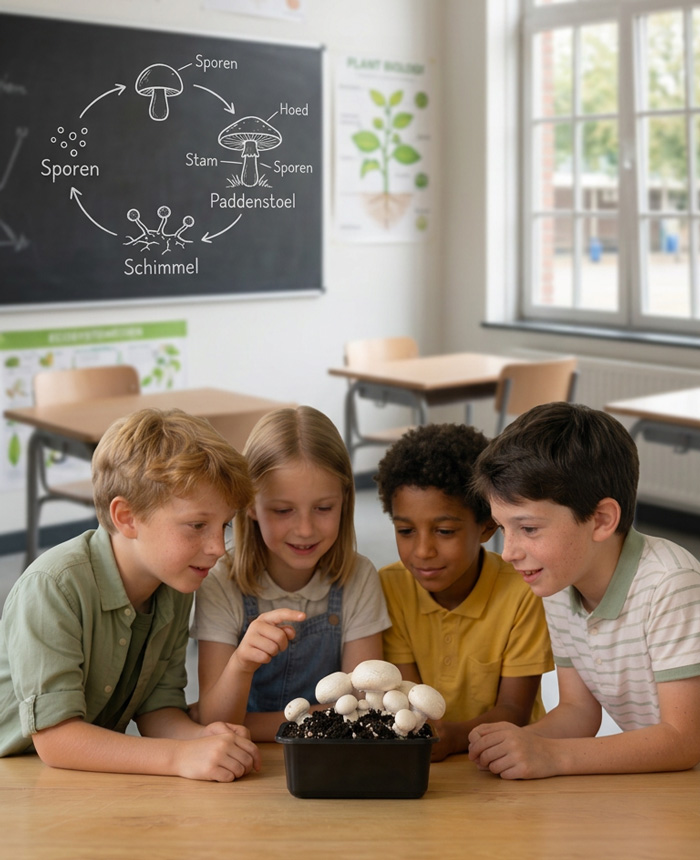
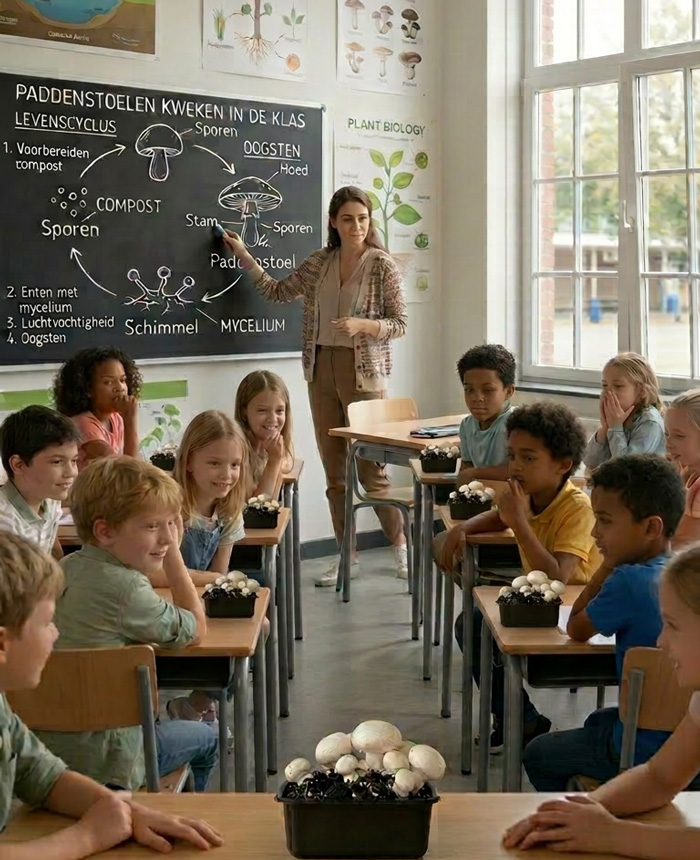
Students discover the life cycle of fungi: from mycelium to the mushroom on their plates. They see how fast everything grows and what conditions are important.

Sustainability
With a small grow kit, you demonstrate how food can be produced locally and efficiently. The project ties in nicely with themes such as nature, the environment, recycling and food waste.

Healthy nutrition
By harvesting themselves, children become curious about new flavors. You can easily pair the project with a cooking activity, tasting or lesson on healthy eating.

Investigative learning
Students work in small groups, measure growth, take pictures and keep a log. Thus, they combine collaboration, language, math and world orientation in one project.
Mushrooms Grow Kit
Schools choose from our 3.5L kits: white or brown mushrooms, yellow or gray oyster mushrooms, or a mix of all for variety. Each kit comes with lesson information, simple instructions and worksheet examples for immediate classroom start-up.
- Class Pack 3.5L White Mushrooms:
Students watch classic mushrooms grow. Includes lesson plans and recipe ideas. - Class Pack 3.5L Brown Mushrooms:
More harvest, perfect for cooking. With growth chart and observation tasks. - Class Pack 3.5L Oyster Mushroom:
Fast growing, fun flavors. Ideal for experimentation. Guidance with growing tips and sustainability lesson. - Custom mix package
Combine species for entire class. Fully customized advice, teaching materials and bulk delivery.
Ready to use, no experience required. Request a quote for your group size.
Why mushrooms in the classroom?
Experiences of schools


